Best Wooden Montessori Toys (2026): My 10 Picks for Babies and Toddlers That Last for Years
Want to give your little one a wooden Montessori toy that's genuinely useful, builds fine motor skills without batteries or screens, and doesn't end up at the bottom of the toy bin after 3 weeks? Let's look at it together. Here are the 10 Montessori-style wooden toys I keep after going through dozens of models: from a first rattle for a baby learning to grab to the knobbed cylinders a 3-year-old works through with real concentration.
Why Choose a Wooden Montessori Toy Over a Noisy Plastic One
A wooden Montessori toy is the opposite of the toy "that blinks and talks for your child." Wood is quiet, natural and durable, and above all, it doesn't do the thinking for your little one. Your child makes the sounds, the story, the challenge. The plastic toy that sings "Great job!" every time a button is pressed teaches a child to wait for a reward from outside. Montessori wood is the reverse: the reward comes from the child, when the piece fits the right hole or the tower stays up.
To understand the marketing around the word "Montessori," I recommend my guide to the Montessori label and marketing, because not everything is truly Montessori, even when it's printed big on the box. My list below is Montessori-inspired wooden toys: natural materials, one challenge per toy, self-correcting when possible, usable alone by a child of the right age. No official label needed (there isn't one), just a good fit with the method.
My 4 Rules for Judging a Good Montessori-Style Wooden Toy
Before I give you my list, here's what I check in my notebook before keeping a toy:
- Responsibly sourced wood (FSC-certified when possible): pine, beech, birch, with non-toxic, water-based paint. If I can't tell what the finish is, I pass.
- One challenge at a time: a shape sorter ONLY sorts shapes. No music, no lights. Wood already sounds great on its own when pieces knock together.
- Self-correcting when possible: the piece won't fit in the wrong hole. Your child sees the mistake without a grown-up saying "No, not like that." That's the heart of the Montessori method.
- At least 3 years of use: a wooden Montessori toy should survive the playroom, the siblings and the resale. If I can't see it lasting through three stages of development, it doesn't make my list.
If you want to dig into the age range where this category shines most, see my guide to toys for ages 1 to 3: it's the golden age of wooden Montessori toys, when every well-chosen toy gives your little one a real boost in independence.
Top 10 Wooden Montessori Toys: My 2026 Picks
1. TOWO Stacking and Nesting Boxes
Stacking boxes are THE first truly useful Montessori-style toy. TOWO's set has 10 boxes to nest or stack, numbered 1 to 10 with a colorful animal and its name on the side. At 9 or 10 months, your baby loves knocking the tower down. Around 14 months, they start trying to stack on their own. By 2, they build towers that hold, and the numbers and animal names become first words. Three stages of development, one toy.
A quick honest aside: PlanToys (a great eco-friendly wooden brand for babies) makes lovely stackers too. I picked TOWO because the numbers and animals keep it useful long after the stacking phase.
TOWO Wooden Stacking and Nesting Boxes
Stack and nest
2. Hape Wooden Creative Peg Puzzle: Sort, Stack, Match
A clever classic in the wooden toddler toy world: chunky wooden shapes in four color families (circles, squares, rectangles, triangles) that slide onto pegs, on a base that is itself a 4-piece jigsaw puzzle. Self-correcting at every step: a triangle won't slide onto the circle peg, and the base only fits together one way. Your toddler sorts by shape, then by color, then stacks from light to dark.
A great fit from around the first birthday through age 3 (check the age grade on the listing). Ludik's pick for visits to Grandma's: compact, sturdy, timeless.
Hape Wooden Creative Peg Puzzle
Sort and stack
3. BOHS Montessori Knobbed Cylinder Blocks
The wooden Montessori toy par excellence for working on the pincer grasp (thumb and index finger). Four wooden blocks, each with six colored knobbed cylinders that go from big to small, to put back in the right holes. Radically self-correcting: a cylinder that's too big won't go in, one that's too small sinks and wobbles, and your child figures it out alone. It's exactly what Maria Montessori was after in her classroom materials.
Best from around 2 to 2½, truly mastered around 3. Check the age grade on the listing: the smallest cylinders are tiny, so I keep this one for kids past the put-everything-in-the-mouth stage. Solid wood, simple colors, and a toy that lasts. It's one of my go-to gifts for a second or third birthday.
BOHS Montessori Knobbed Cylinder Blocks
Pincer grasp
4. GOKI Wooden Animals Knob Puzzle
The first puzzle. GOKI, a German brand known for traditional wooden toys, makes knob puzzles with easy-grip wooden pegs for little fingers. Four chunky animals (a puppy, a duckling, a bunny and a kitten), water-based paint. The listing says ages 1 and up; most toddlers really get it between 18 months and 2½.
Why is it in my top 10 despite being one of the most affordable toys here? Because it's one of the rare budget-friendly toys that checks all 4 Montessori-style rules: real materials, one challenge, self-correcting (the piece won't go in unless it's in its spot), and usable alone by an 18-month-old.
GOKI Wooden Farm Animals Peg Puzzle
Ages 1 to 3
5. Joliecraft Wooden Ring Rattle: A First Grab
The wooden ring rattle is the very first wooden Montessori-style toy you can put in your baby's hand. This one is a smooth wooden ring with a soft crocheted elephant, sized for the little hand learning to grab around 3 or 4 months. Easy to hold, gentle to shake, and the wooden ring is great for gnawing when the first teeth start pushing.
The Montessori idea here: the weight of the wood and the texture of the yarn give your baby honest feedback through their hands, unlike a noisy plastic rattle that distracts instead of teaching the hand. Simple, lasting, easy to pass on.
Joliecraft Woodland Friends Wooden Ring Rattle
First grab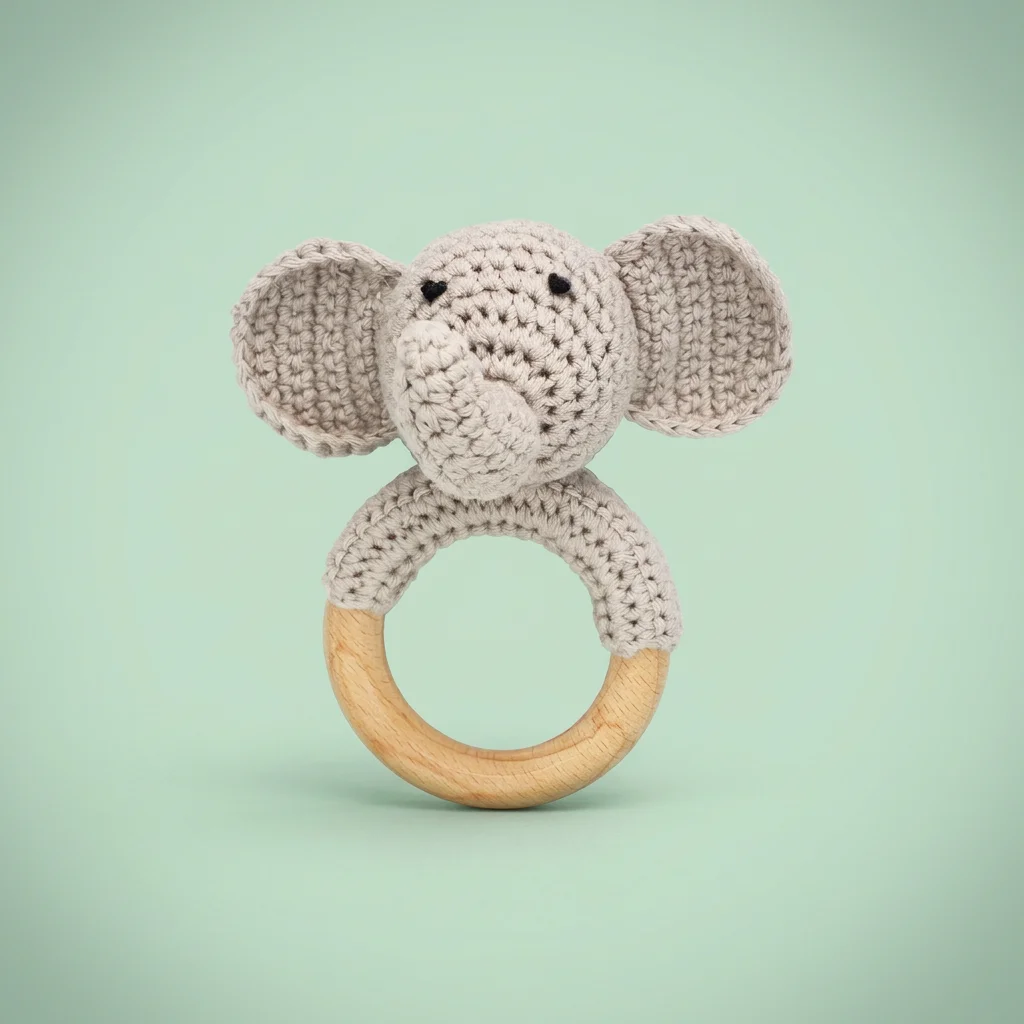
6. Lehoo Castle Wooden Musical Instruments Set
A little detour into music, but still all wood and all Montessori-style: a set of small acoustic wooden instruments for toddlers (drum, shakers, xylophone and more). No batteries, no speaker, just real sound made by your little one's hands. See it on Amazon (paid link).
The Montessori spirit here: each instrument does ONE thing. The drum booms, the shakers shake, the xylophone rings out clear notes. No "12 pre-recorded songs" mode to kill the exploring. Ludik's pick for a first taste of music from about 18 months (the age on the listing).
7. A Wooden Push Walker or Ride-On
The wooden walker or ride-on is the XL version of the wooden toddler toy, built for gross motor skills. In the U.S., the Radio Flyer wooden walker wagon is the classic: a sturdy push toy that doubles as a wagon for hauling stuffies and blocks around the house. As soon as your little one pulls up to standing (around 12 months on average), they're the ones driving, no batteries, no fake engine sounds, just their legs and their balance.
Why Montessori-inspired? Because your child sets the pace, gets back up alone after a tumble, and learns cause and effect (I push, it rolls). If you'd like more wooden toys for this age, see my Montessori toys category.
8. KAPLA 200-Plank Wooden Construction Set
KAPLA is THE wooden toy that goes beyond Montessori: pure open-ended building. 200 identical pine planks, no instructions, no batteries, no loud colors. Your child invents the tower, the bridge, the castle, the penguin. First they stack and knock down, then they build (around 3), then they dream up complex structures (5 and up). See it on Amazon (paid link).
I slip it into my wooden Montessori top 10 because even though KAPLA isn't "branded Montessori," it checks every rule of the method: one isolated challenge (place without toppling), self-correcting (the tower falls or it doesn't), real material, usable alone, and 10 years of play easily. One of my all-time favorites.
9. A Wooden Cooking Set: Pretend Play
Around 18 to 24 months, pretend play begins: "I'm doing it like Mommy, like Daddy." A small wooden cooking set (a pan, utensils, play food to "slice") sparks hours of make-believe. Hape and Melissa & Doug both make good wooden ones, with water-based paint and pieces sized for small hands.
Why is it in my wooden Montessori top 10? Because Maria Montessori put practical life at the center of her method: pouring, stirring, cutting, tidying up. A wooden cooking set is practical life in miniature. Your child copies what they see you do every morning, and learns the sequence of actions. No need for an expensive learning tower: a cooking set on the floor already does the job.
10. An Adjustable Montessori Learning Tower
The famous Montessori learning tower: a secure wooden platform with rails that lets your little one climb up to counter height to cook with you, see what's happening on the table, or reach the sink to wash their hands on their own. Look for an adjustable platform height, sturdy rails on all sides and a wide, stable base. I show the one I'd pick in my Montessori label guide.
It's the most debated item on my list: some parents feel it's a lot of money for what it is. Here's my honest take: wait until your little buddy stands steadily on their own (well after the first birthday), because before that it isn't safe. And between a premium solid-wood tower and a simpler adjustable one with sturdy rails, your child won't feel the difference. Spend the savings on 2 or 3 solid sensory toys instead. I talk about it in my guide to how much to spend on toys.
How to Choose the Right Wooden Montessori Toy for Your Child's Age
No need to buy all 10 toys on this list. The Montessori method is about buying less and choosing better. Here's what I recommend by age:
- 0 to 12 months: the wooden ring rattle (Joliecraft) is plenty as a first wooden Montessori toy. Around 8 to 10 months, add the TOWO stacking boxes. Don't be tempted by "complete 0 to 3 years" bundles of 30 pieces your baby will never touch.
- 12 to 24 months: the Hape peg puzzle, the GOKI knob puzzle and a wooden push walker. Three wooden toys, three kinds of skills (fine motor, fitting, gross motor). That's enough.
- 2 to 3 years: the BOHS knobbed cylinders, KAPLA and the Lehoo Castle instruments. This is the "brain getting organized" stage: pincer grasp, building, exploring sound.
- 3 and up: a learning tower for practical life, a wooden cooking set for pretend play, and KAPLA stays for open-ended building until 12.
Still unsure after this list? Try my Toy Finder quiz: 5 questions, 5 ideas, 30 seconds, matched to your child's age, what makes their eyes light up and what matters to you.
The Bottom Line: My Favorite in This Wooden Montessori Top 10
If I could keep only one combo, it would be the TOWO boxes, the BOHS cylinders and KAPLA: three wooden Montessori-style toys that cover the first 3 years, last a decade, get passed down to siblings, and never impose a script on your child.
Montessori wood isn't a trend for fancy playrooms. It's a return to basics: a real material, one challenge at a time, the child at the center. To go further into the philosophy behind it, read my guide to the Montessori label and what it's really worth, so the marketing doesn't fool you.