Free Printable Christmas Activity Pages for Kids: My 12-Page Activity Book, Ages 3 to 8
The days are getting shorter, the tree isn't up yet, and your little one is already asking "how many more days until Christmas?". To help everyone wait, I made a free printable Christmas activity book: dot-to-dots, shadow matching, a seek and find in Santa's workshop, a maze, spot the 6 differences and a Christmas word search. There's something for preschoolers from age 3 all the way to 2nd graders, and the answer key is at the end. Print it for your kids, your class or your homeschool group.
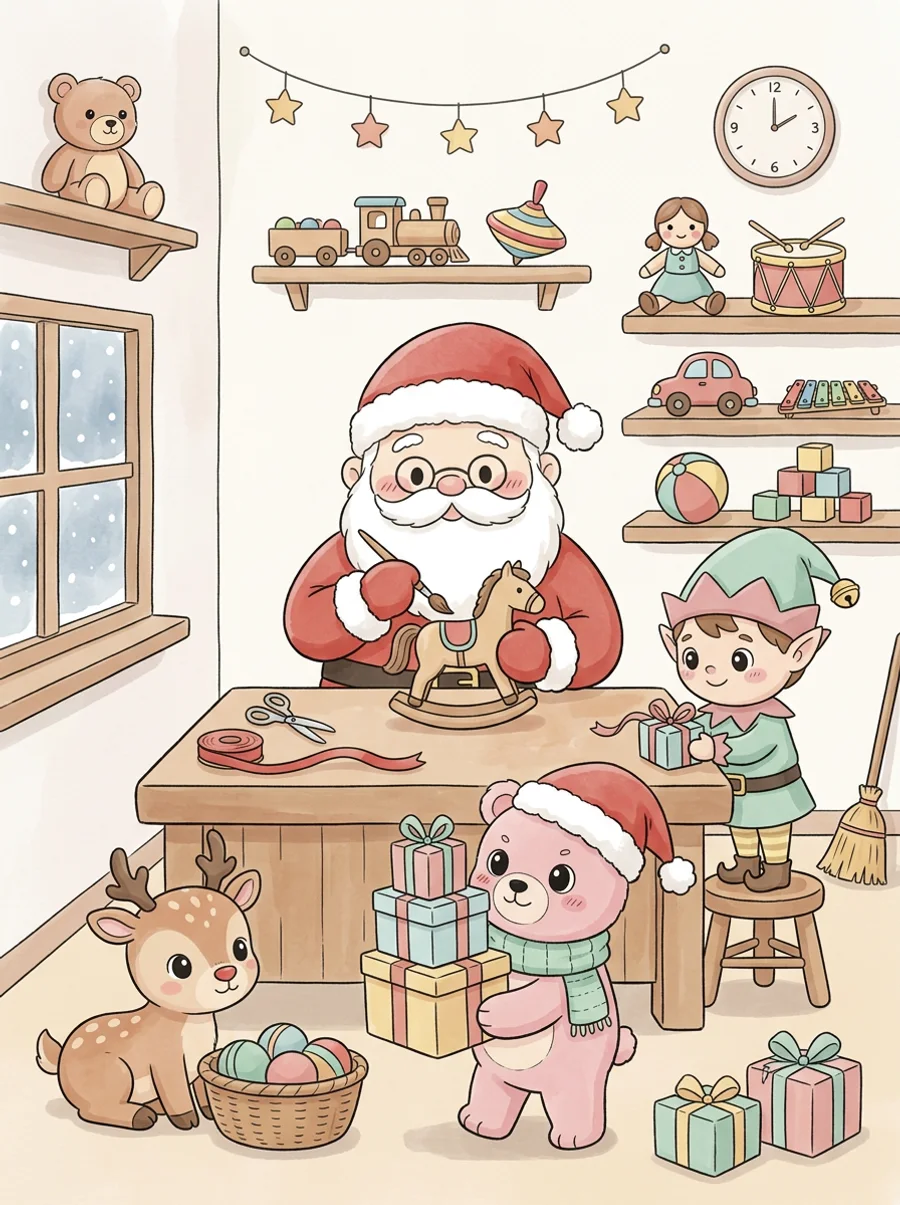
My Christmas Activity Book
12 US Letter pages: 9 games for ages 3 to 8 (dot-to-dots, shadow match, counting, patterns, seek and find, maze, spot the difference, word search) and 2 pages of answers.
⬇ Download the free PDF (2.3 MB)Free, no sign-up, no email address.
What's inside my Christmas activity book
My activity book has 12 pages, from the easiest to the hardest. Print only the ones your kiddo will enjoy: every page stands on its own.
- Page 1, how to use it: which game for which age, and my tips so it never turns into a chore.
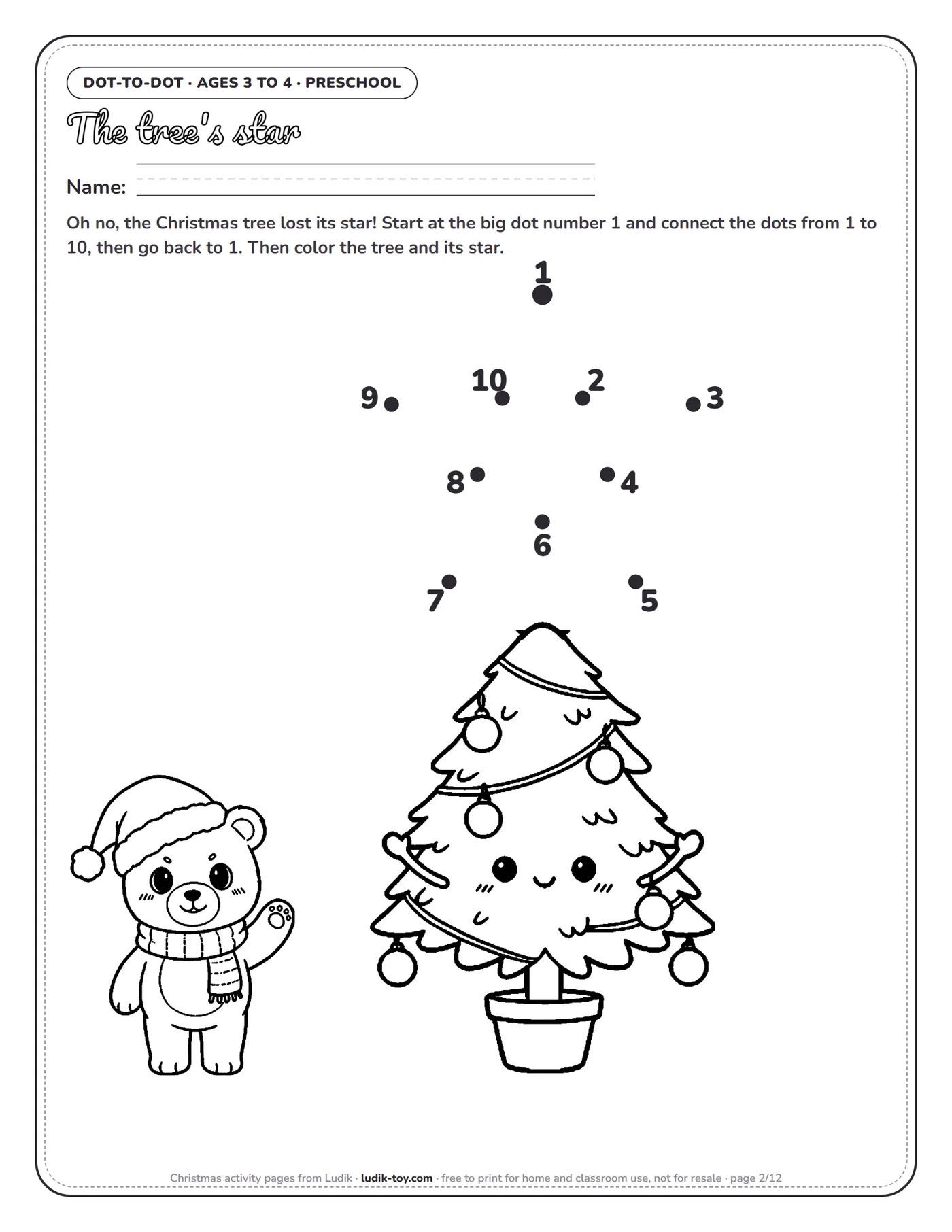
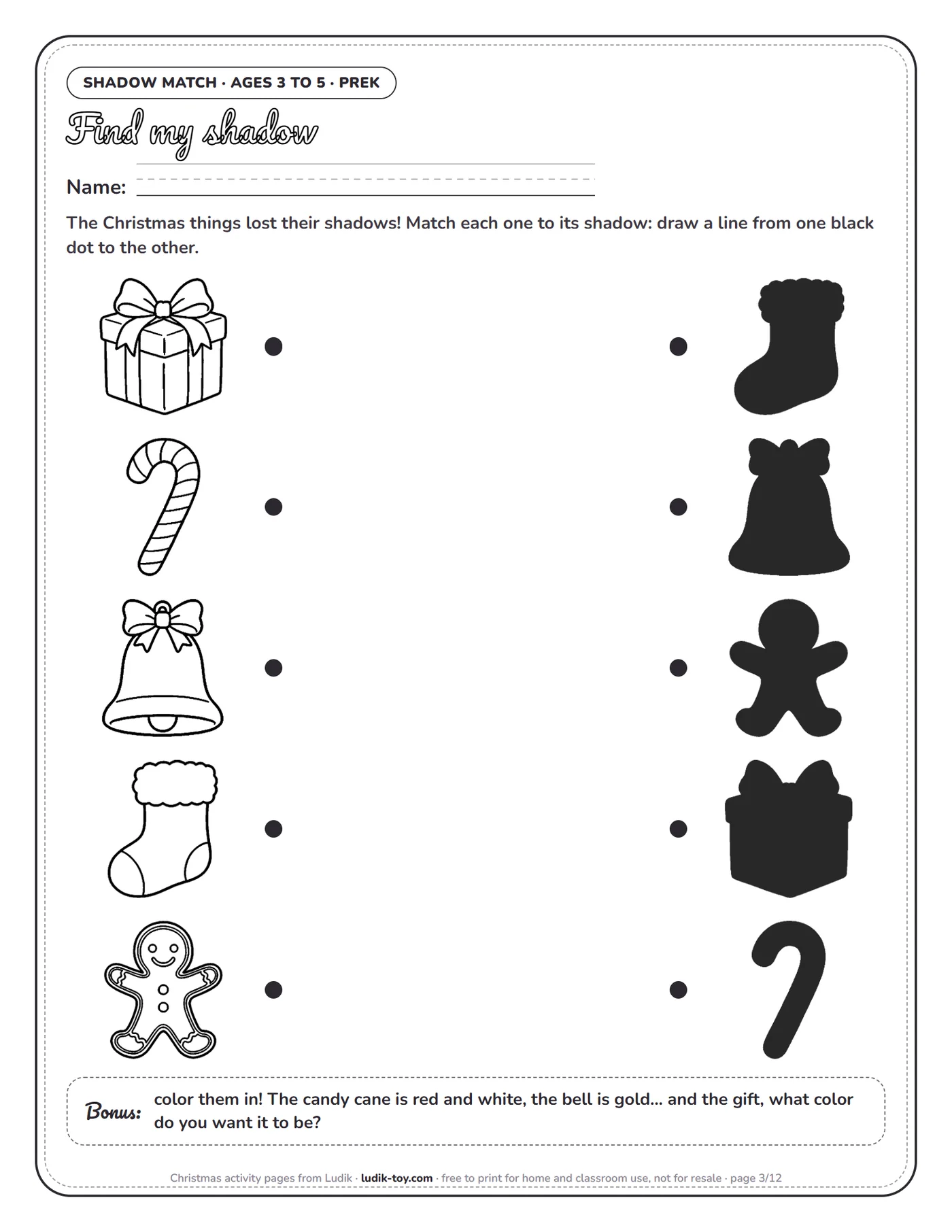
- Pages 2 to 4, little ones (ages 3 to 4, preschool): the tree's star to connect from 1 to 10, Christmas things to match with their shadows, and gifts, ornaments, candy canes and bells to count.
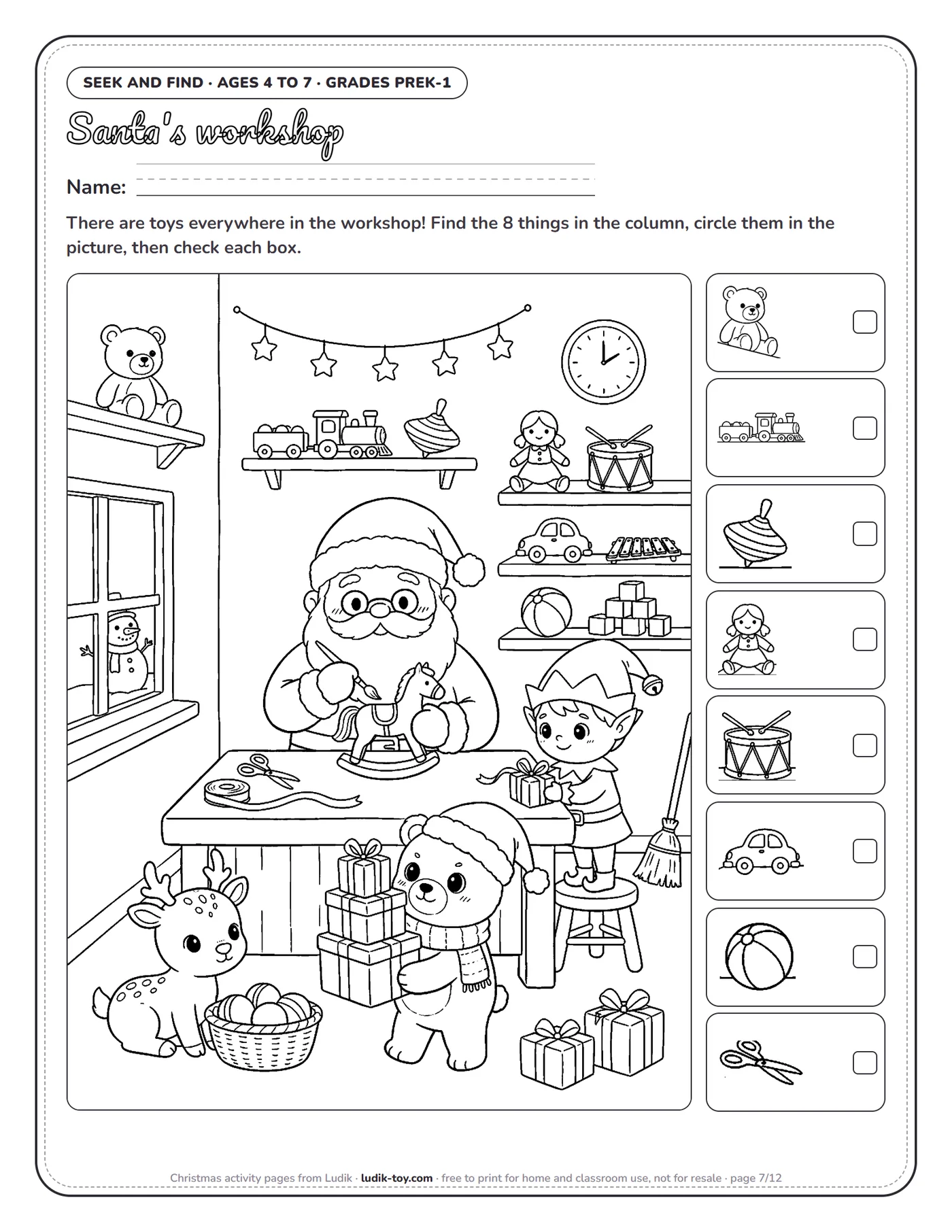
- Pages 5 to 7, middle kids (ages 4 to 6, Pre-K and kindergarten): "what comes next?" patterns, the big tree dot-to-dot from 1 to 30, and the seek and find (I Spy) in Santa's workshop, with 8 toys to spot.
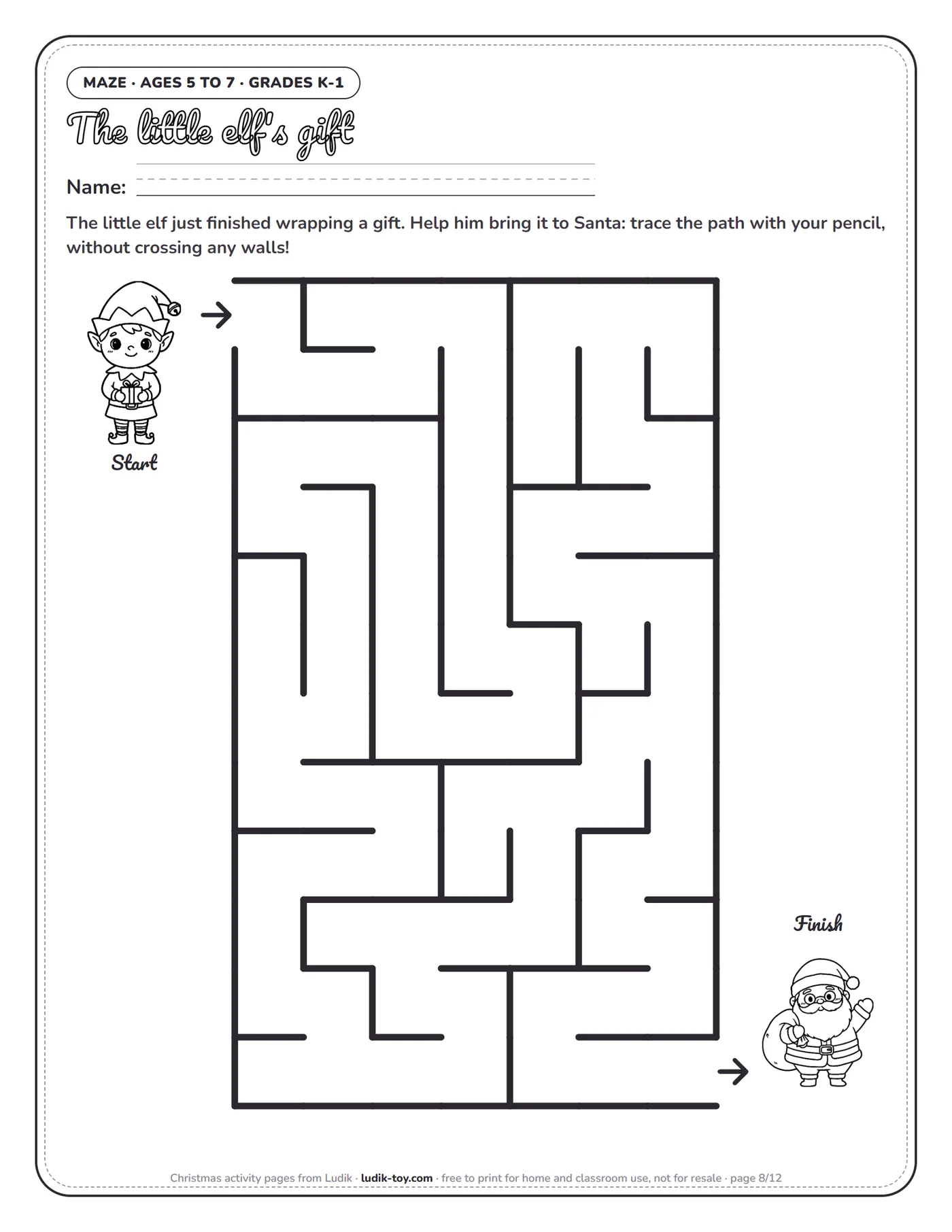
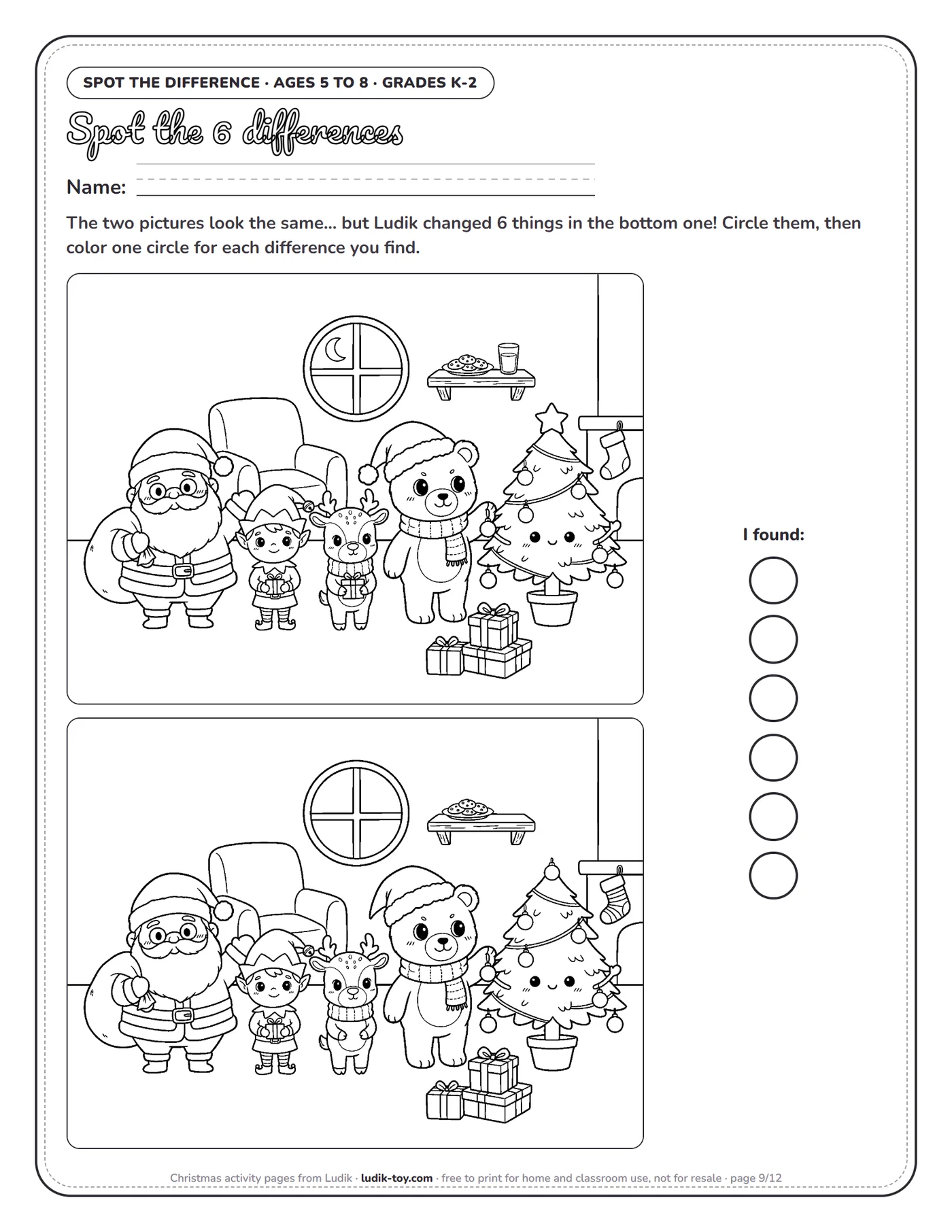
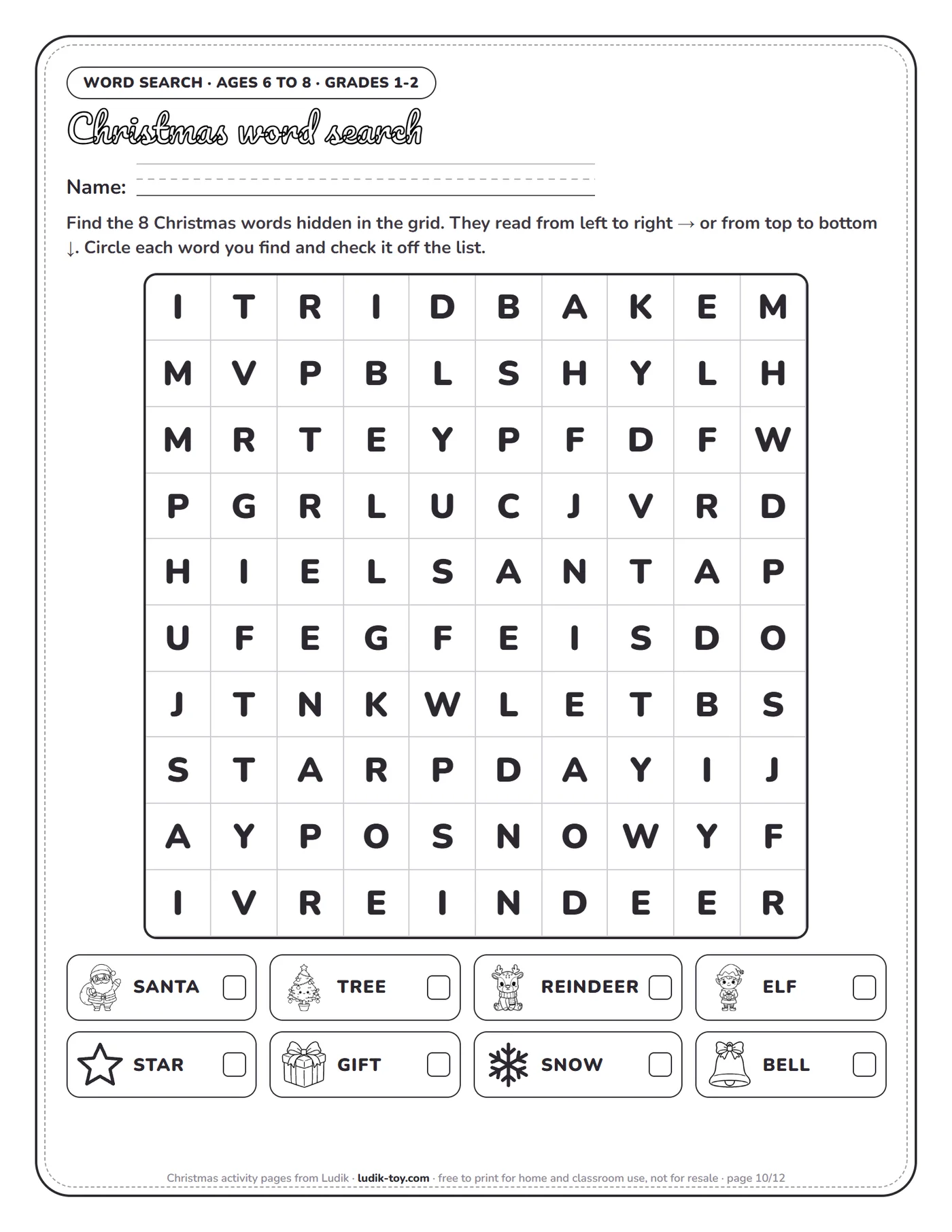
- Pages 8 to 10, big kids (ages 5 to 8, kindergarten to 2nd grade): the little elf's maze, spot the 6 differences, and a Christmas word search for beginning readers.
- Pages 11 and 12, the answer key: the circled toys, the differences, the maze path and the word search grid.
And once a game is done, every page turns into a coloring page: the dot-to-dot tree, the toys in the workshop, the pattern pictures...
🔍 Click a page to see it full size and flip through the book.
Which Christmas activity for which age?
A game that's too hard, and a 3-year-old gives up. A game that's too easy, and a 7-year-old is bored in two minutes. So I sorted the pages by age, with a badge at the top of each one. They're guideposts, not tests: every child goes at their own pace.
| Age | Pages | The games | What it practices |
|---|---|---|---|
| Ages 3 to 4 (preschool) | 2, 3 and 4 | The star from 1 to 10, shadow matching, counting things | Number order, noticing shapes, counting small groups up to 5. |
| Ages 4 to 6 (Pre-K and kindergarten) | 5, 6 and 7 | Patterns, the tree from 1 to 30, the seek and find | Repeating patterns, numbers up to 30, paying attention to details. |
| Ages 5 to 8 (kindergarten to 2nd grade) | 8, 9 and 10 | The maze, spot the difference, the word search | Planning a path, comparing two pictures, reading words in capital letters. |
What each game practices, without feeling like homework
These are games first. But each one quietly works on something kids are learning in preschool, Pre-K and kindergarten. My favorite trick while your little one plays: ask "How did you figure it out?". Putting it into words is half the learning.
Counting things: up to 5 is perfect at ages 3 to 4
On my page 4, there are never more than 5 of the same thing: 3 gifts, 5 ornaments, 4 candy canes and 2 bells, scattered around the page. That's on purpose. Counting things that are scattered is harder than counting things in a line, and the Common Core standards for kindergarten ask kids to count up to 10 things in a scattered arrangement (and up to 20 in a line). My tip: put a finger on each object while counting out loud, and cross it off with a little line so you don't count it twice.
What comes next: where math begins
Ornament, candy cane, ornament, candy cane... and then? Spotting a pattern that repeats and continuing it is one of the early math goals in the Head Start Early Learning Outcomes Framework, the framework Head Start programs use for preschoolers: "Child understands simple patterns". On the last row of my page 5, your kiddo makes up their own pattern and you have to guess what comes next. The roles flip, and they become the game master.
Dot-to-dots from 1 to 30
The little star stops at 10, the big tree goes all the way to 30. Kindergartners learn to count to 100 by ones and by tens, so connecting the dots to 30 is a nice, doable stretch at ages 5 to 7.
Sources: Common Core State Standards, Kindergarten, Counting and Cardinality (K.CC.A.1 and K.CC.B.5), and the Head Start Early Learning Outcomes Framework, Mathematics Development (preschool), checked on November 18, 2026.
Shadows, seek and find and spot the difference: learning to look closely
These three games ask for the same thing: look for a long time, compare, notice a detail. For the shadows, look at the shape: the bell is wide at the bottom, the candy cane has a hook. In the workshop, the 8 toys to find are cut right out of the drawing itself, so they're definitely in there, even when they hide on a shelf. For the differences, my tip: compare the two pictures piece by piece, the top first, then the middle, then the bottom.
The maze and the word search: for the big kids
The maze has only one path, but it's a long one: you have to look ahead before you draw. The word search is made for beginning readers in 1st and 2nd grade: 8 Christmas words in capital letters (SANTA, TREE, REINDEER, ELF, STAR, GIFT, SNOW, BELL) that only read from left to right or from top to bottom. Each word has its own little picture in the list, to help kids who are just starting to read. I checked the grid word by word: each one shows up exactly once.
My ideas for making the wait until December 24 fun
An activity book works even better when it becomes a little ritual. Here's how I make it last:
- The road trip folder: a few pages, a clipboard or a big book to lean on, and three crayons in a pencil case. Perfect for the drive to Grandma's over the holidays or the doctor's waiting room.
- One game a day: slip one next to my printable Advent calendar, as one more little surprise.
- The afternoon of the 24th: the longest afternoon of the year! Save the word search and the spot the difference for then.
- Differences as a family: two kids, two copies, and whoever finds all 6 differences first wins. Big kids can also time the little ones.
- Color it afterward: once the game is done, every page becomes a coloring page. Hang the best ones on the fridge.
And if your kiddo wants more, my favorite family board games for Christmas take over, around the table this time.
For teachers, homeschoolers and daycare providers
You're welcome to print and copy this activity book for your classroom, homeschool co-op, library, after-school program or daycare. The only rule: don't sell it. No prep, print and go: all the game pages are black and white (ink-friendly) and made for the copier, and the answer key prints separately. Each page shows the age and the grade level in its badge. The little-ones pages fit preschool, the patterns and the seek and find work well in Pre-K and kindergarten, and the word search is just right for 1st and 2nd grade: great for the last week before winter break, or as early-finisher work.
If you share it with colleagues or on your blog, please share the link to this page rather than the file: this is where I'll keep the book up to date. A game your class is missing? Write to me.
Have fun together. And if your little one spots all 6 differences on the first try, that deserves a big high five from you!