Winter Coloring Pages: Free Printable PDF for Ages 2 to 7
Snow day, gray day, or just one of those afternoons when everyone is going stir-crazy indoors? I made a free printable winter coloring book for your little one, with my friends the snowman, the little penguin and the groundhog. There are extra-bold lines for toddlers, sledding and snowball scenes for preschool and kindergarten, plus a tracing page, a maze and a snowman to finish. Print, grab the crayons, and stay cozy.
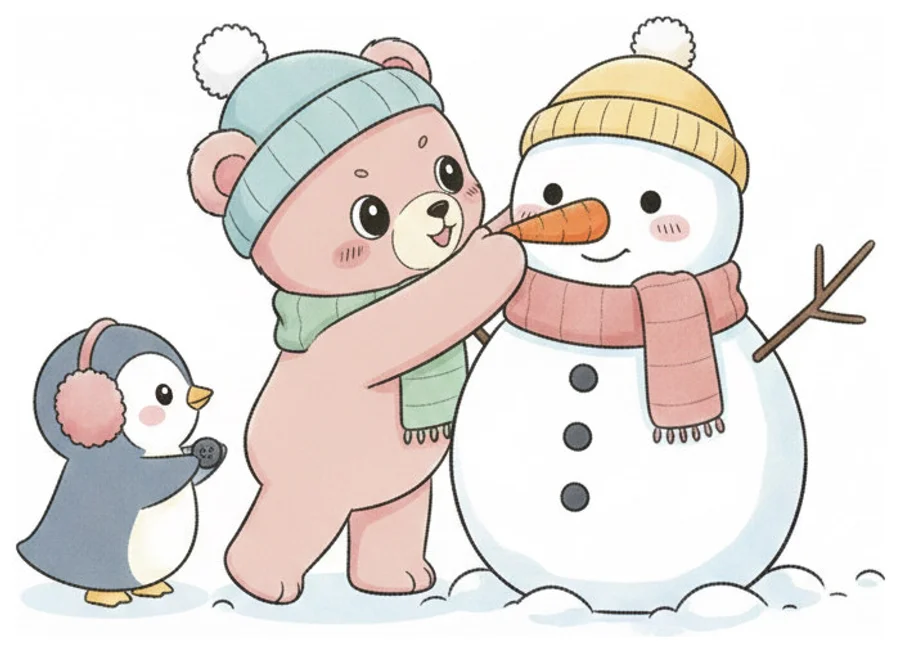
My winter coloring book
13 US Letter pages: 9 coloring pages in 3 levels, a tracing page, a maze and a snowman to finish.
⬇ Download the free PDF (2.9 MB)Free, no sign-up, no email required.
What's Inside My Winter Coloring Book
My book has 13 pages, sorted by age. Print only the ones your kiddo will love: there's no order to follow.
- Page 1, the guide: which page for which age, plus my crayon tips.
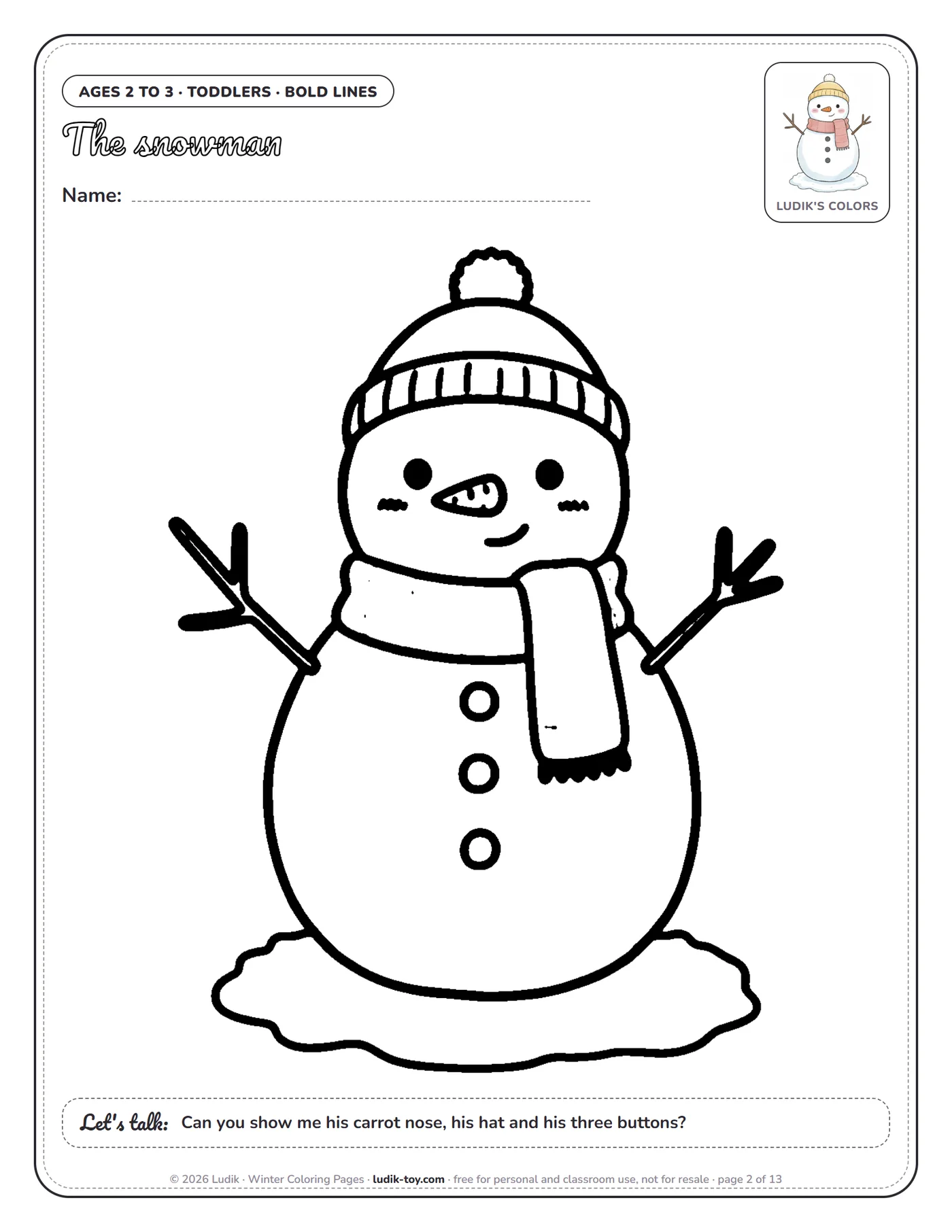
- Pages 2 to 4, toddlers (ages 2 to 3): the snowman, me in my winter hat and the little penguin. One character per page, with extra-bold lines.
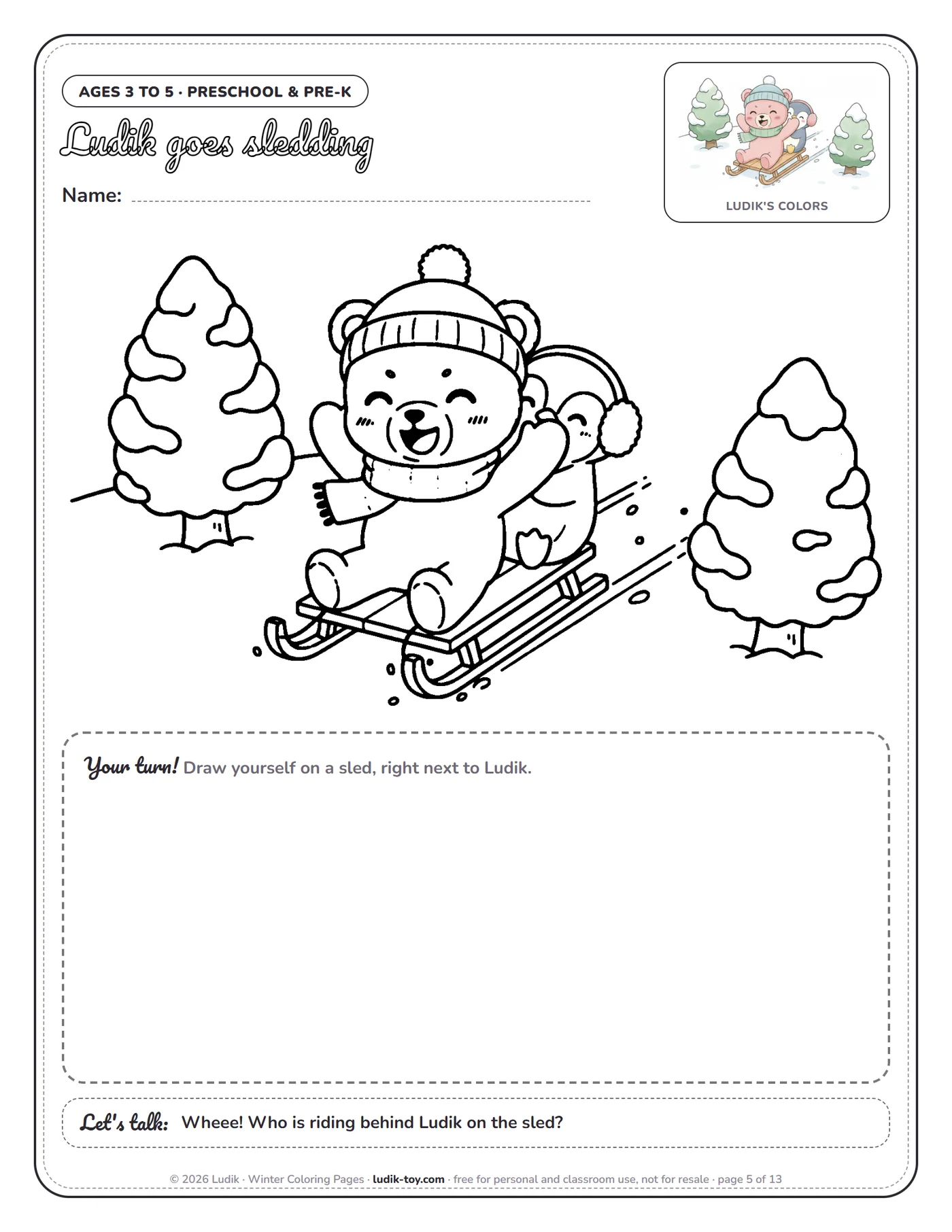
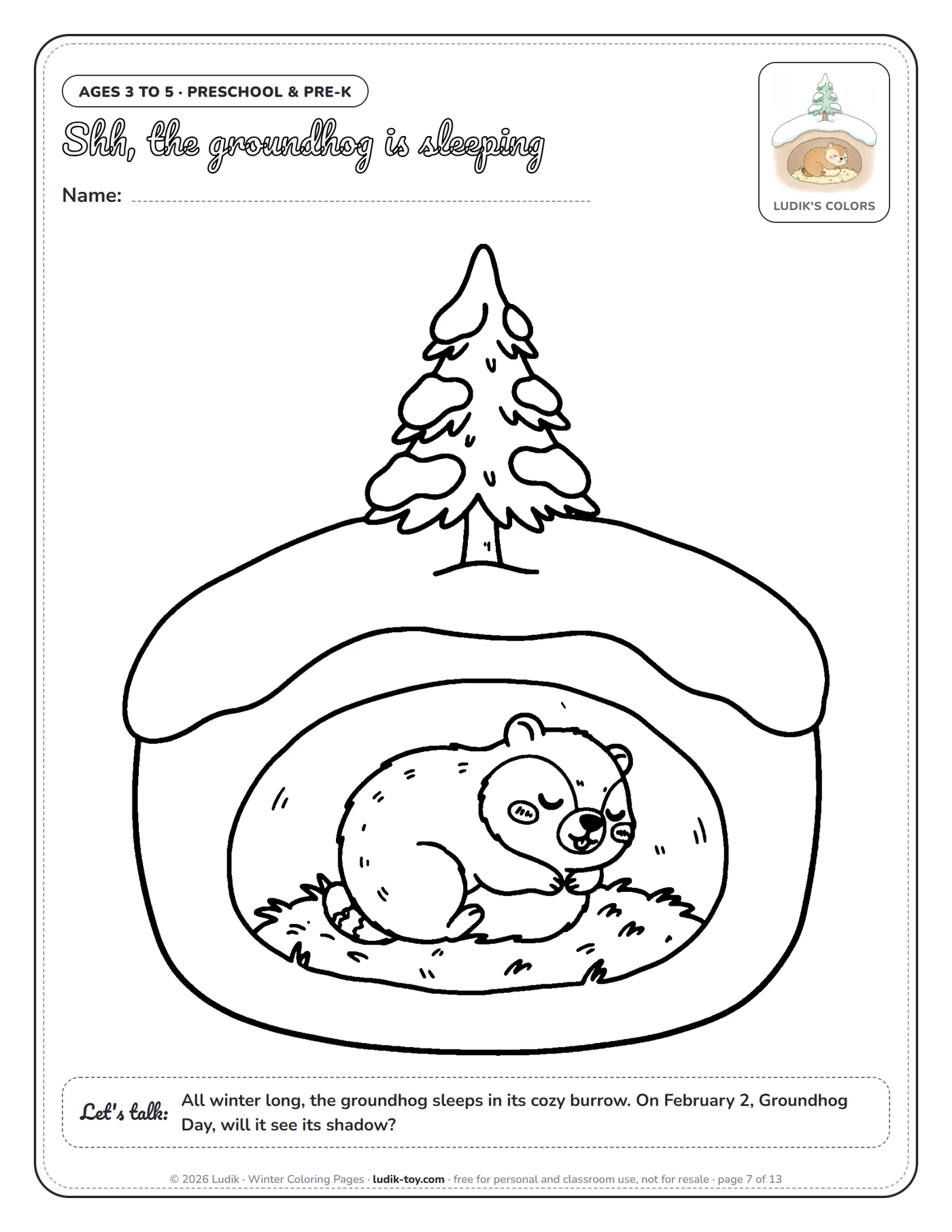
- Pages 5 to 7, preschool and Pre-K (ages 3 to 5): sledding, building a snowman, and the groundhog asleep in its burrow. Under the wide scenes, a big “Your turn!” box is waiting for a drawing.
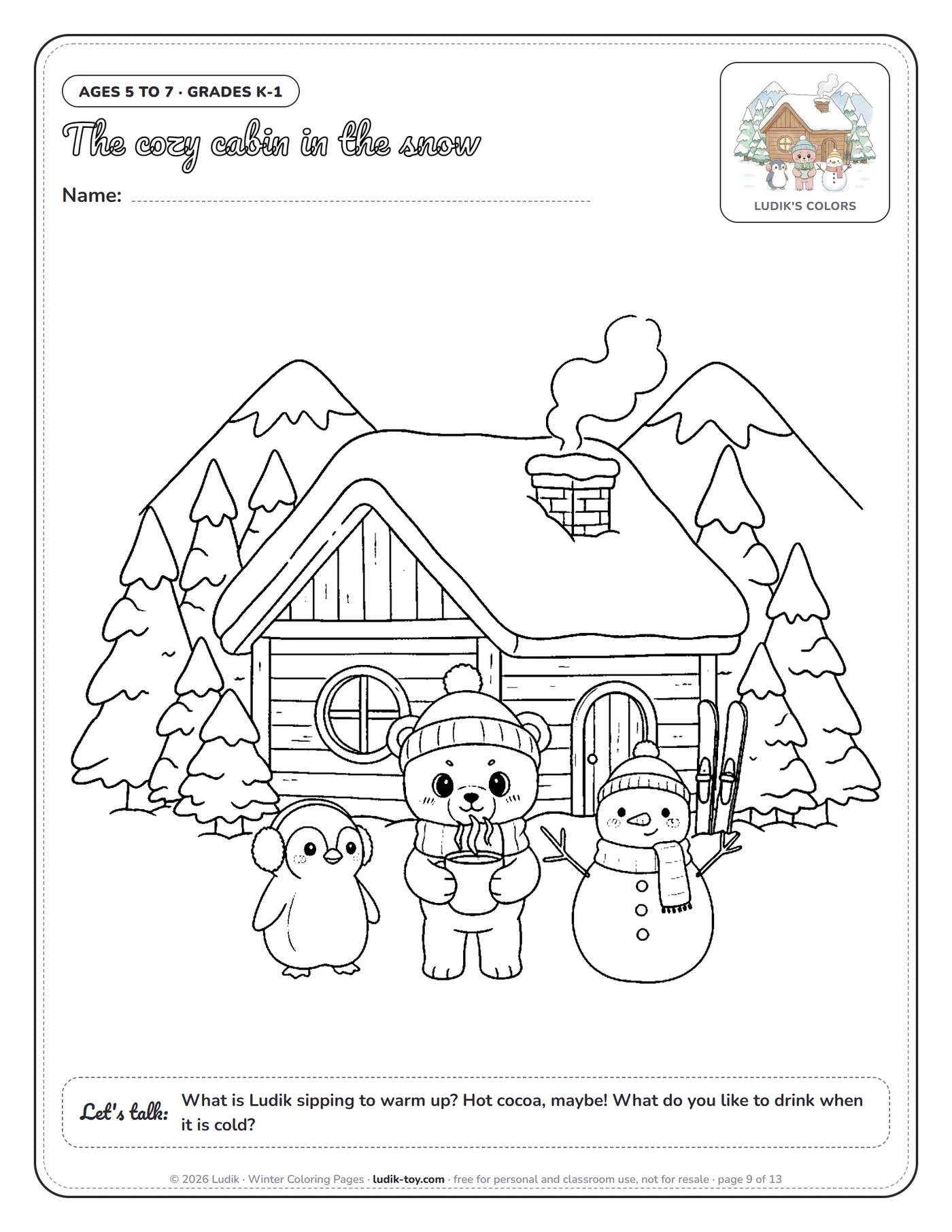
- Pages 8 to 10, kindergarten and 1st grade (ages 5 to 7): skiing down the slope, the cozy cabin in the snow and a big snowball fight, with more details to color.
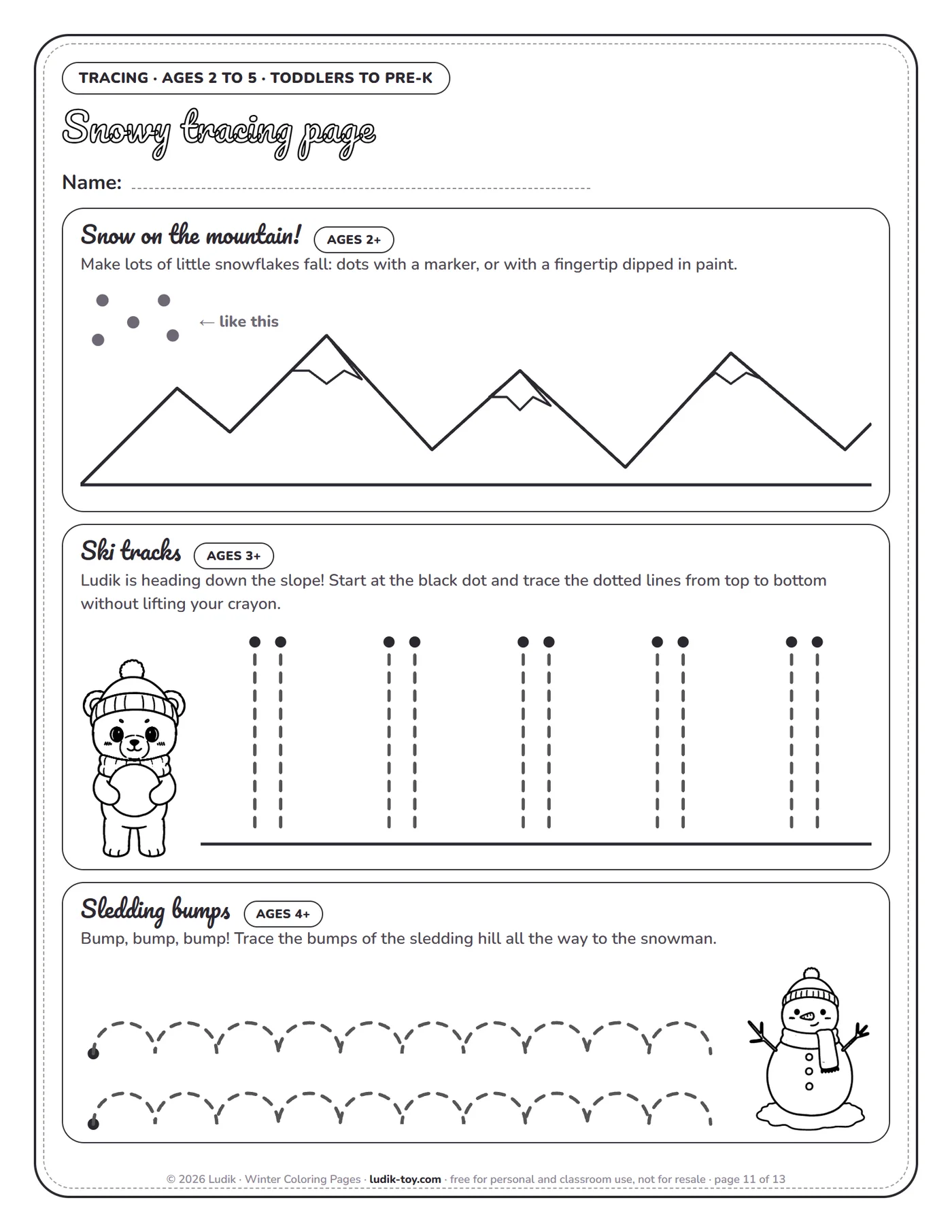
- Page 11, tracing: snowflake dots, ski tracks and sledding bumps, for pre-writing practice.
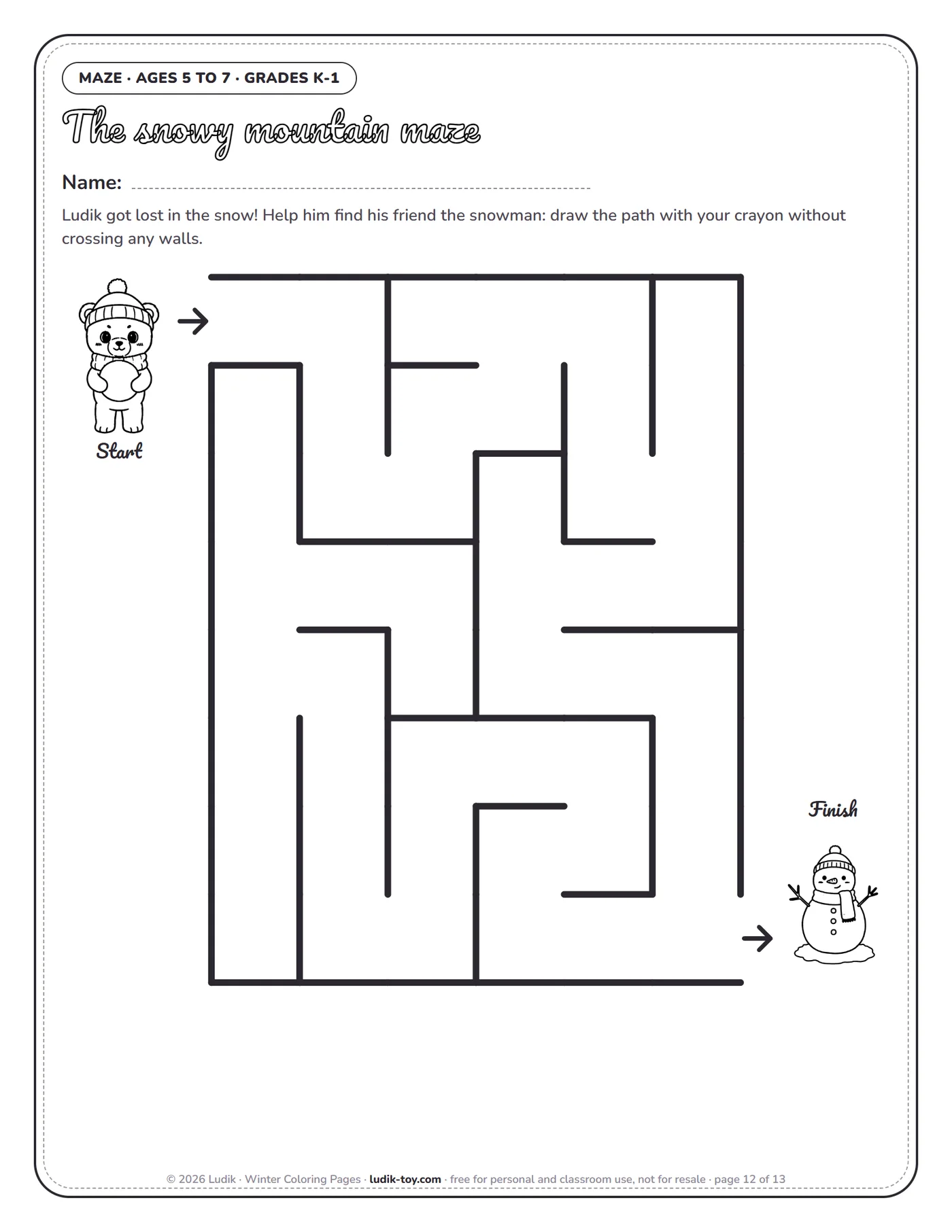
- Page 12: the snowy mountain maze, to help me find the snowman.
- Page 13: the snowman to finish, with a checklist: eyes, carrot nose, buttons, hat and scarf.
Every coloring page also has a small color version at the top, a “Name” line like on a classroom worksheet, and a “Let's talk” question at the bottom: something to ask your child while they color.
🔍 Click any page to see it full size and flip through the book.
Which Winter Coloring Page for Which Age?
A page that's too busy, and a toddler gives up after three scribbles. A page that's too simple, and a 6-year-old is bored. So I made three levels, with lines that get thinner as kids grow.
| Age | Pages | What changes | Best supplies |
|---|---|---|---|
| Toddlers (ages 2 to 3) | 2, 3 and 4, then the tracing page (page 11) | One character, extra-thick lines, big spaces. | Chunky crayons, broad-tip washable markers. |
| Preschool and Pre-K (ages 3 to 5) | 5, 6 and 7, plus the snowman to finish (page 13) | A small scene with two or three characters, and a box to draw in. | Jumbo colored pencils, markers. |
| Kindergarten and 1st grade (ages 5 to 7) | 8, 9 and 10, plus the maze (page 12) | Real snowy scenes, with trees, skis and snowballs. | Colored pencils, fine-tip markers. |
Coloring Pages for Toddlers: Why Such Thick Lines?
For the ages 2 to 3 pages, I thickened every line and kept one character per page. At that age, most kids still hold the crayon in their fist, and a page full of tiny details is more discouraging than fun.
The CDC's developmental milestones describe that path well. Around 18 months, a child scribbles. By age 3, many can draw a circle when you show them how. By age 4, most hold a crayon between their fingers and thumb instead of in a fist, and can draw a person with three or more body parts. Thick lines and big spaces meet your little one right where they are.
My Tips for Coloring with a 2-Year-Old
- Chunky tools: crayons, broad-tip markers or jumbo pencils, easy to grab. I show my favorites for little hands in my arts and crafts picks.
- Short sessions: a few minutes is already a great session. Put the crayons away before it turns into a chore.
- Coloring outside the lines? Totally normal. At this age, the fun is leaving a mark of color. Staying in the lines comes later.
- Talk while you color: that's what the “Let's talk” question at the bottom of each page is for. Where's the carrot nose? What color is his hat?
- A purple snowman? Even better. The small color version gives ideas, not rules.
The Tracing Page, in the Order Skills Develop
My page 11 follows the same order. First, snowflake dots, from age 2. Then ski tracks, lines from top to bottom, from age 3. Finally the sledding bumps, a row of little arches, from age 4. My trick for the snowflakes: dip a cotton swab in washable paint and let your little one dot the whole sky.
Source: the CDC “Learn the Signs. Act Early.” milestones at 18 months, 3 years and 4 years, checked November 18, 2026. Every child grows at their own pace: the ages in my book are guideposts, not tests.
Snowy Scenes: Sledding, a Cozy Cabin and a Groundhog Fast Asleep
For the bigger kids, I drew real winter scenes: me skiing down the slope, a log cabin with a snowy roof (and hot cocoa!), and an epic snowball fight. Heading to the mountains or to Grandma's this winter? Slip a few pages into the bag: they're perfect for the car, the airport or a quiet evening at the cabin.
The Groundhog Page: A Groundhog Day Story to Tell
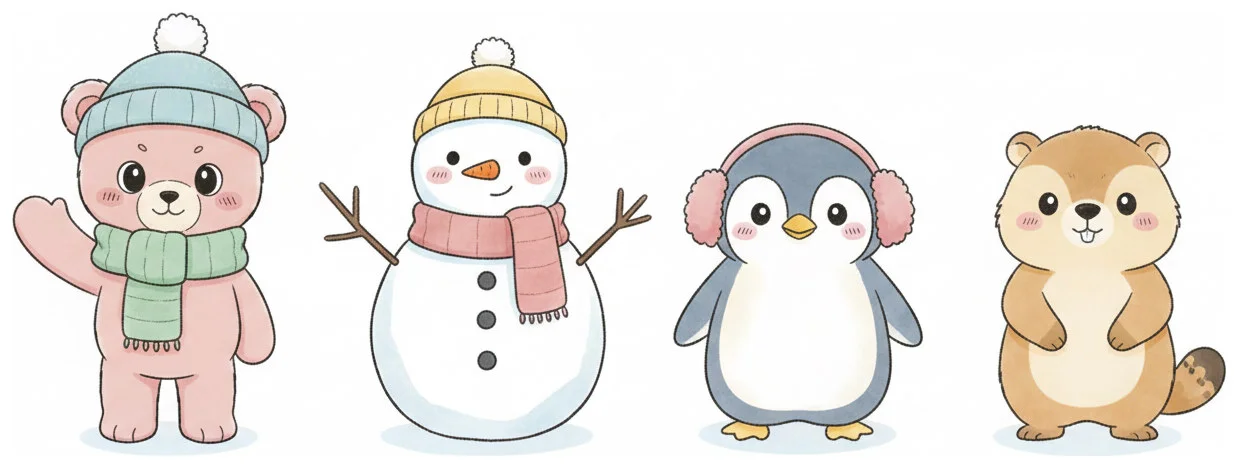
My favorite page? The groundhog. While I'm out sledding, it's sound asleep under the snow. And that's true: groundhogs are real hibernators. Their winter sleep usually starts around late October or early November and lasts until late February or March, in a nest chamber at the very end of their burrow. That's why, every February 2, everyone waits to see whether the groundhog will come out and see its shadow!
In my drawing, it's curled up alone to leave room for the crayons, but your little one can add a few friends, or draw its shadow for Groundhog Day.
Source: “Do groundhogs hibernate? What to know about groundhogs for Groundhog Day,” Penn State (January 31, 2023), checked November 18, 2026.
Snow Day Activities for Kids: My Ideas around the Book
On days when you can't go outside (or when everyone comes back in soaking wet), coloring works even better as a little ritual. Here's how I keep it fun:
- The snow day folder: a few printed pages and a box of crayons, stored up high. It only comes out on snow days or rainy days, so it stays a treat.
- The real snowman, then the paper one: if it snowed, build one outside, then finish the one on page 13 back inside. Does he have a carrot nose too?
- The winter gallery: a string and a few clothespins in the hallway, and every finished page goes on display.
- The “Your turn!” boxes: under some scenes, a big box is waiting. Your kiddo can draw themselves on a sled, right next to me.
- A hot cocoa break: page 9 is the perfect excuse. Color the cabin, then make two mugs for real.
- A story to finish: once the crayons are put away, I'd suggest my free illustrated book, to read in 10 short chapters.
A sheet of paper and some crayons is still one of the best toys in the world: no batteries, no screen, and an imagination running at full speed. I talk about it in my favorite toys without batteries or screens and in why kids play better with fewer toys.
For Teachers, Homeschoolers and Daycare Providers
You're welcome to print and photocopy this book for your classroom, homeschool group, library story time, after-school program or the kids you care for. The only limit: please don't sell it. All the activity pages are black and white and photocopy well. The tracing page makes a nice fine-motor center in preschool or Pre-K, the maze a calm-down activity in kindergarten, and the “Name” line on every page keeps a class set sorted.
Good to know: there's no holiday on any page, just snow, sledding and winter animals. If your school celebrates several winter holidays, this book works for every family in the class, from December all the way to Groundhog Day.
If you share it with colleagues or on your blog, please share the link to this page rather than the file: this is where I'll keep the book up to date. For December, I also made a printable letter to Santa and Christmas coloring pages. A worksheet idea your class is missing? Write to me.
Stay cozy this winter. And if it really snows, bundle up your little buddy like me (hat, scarf and mittens) and head out: the snowman is waiting!